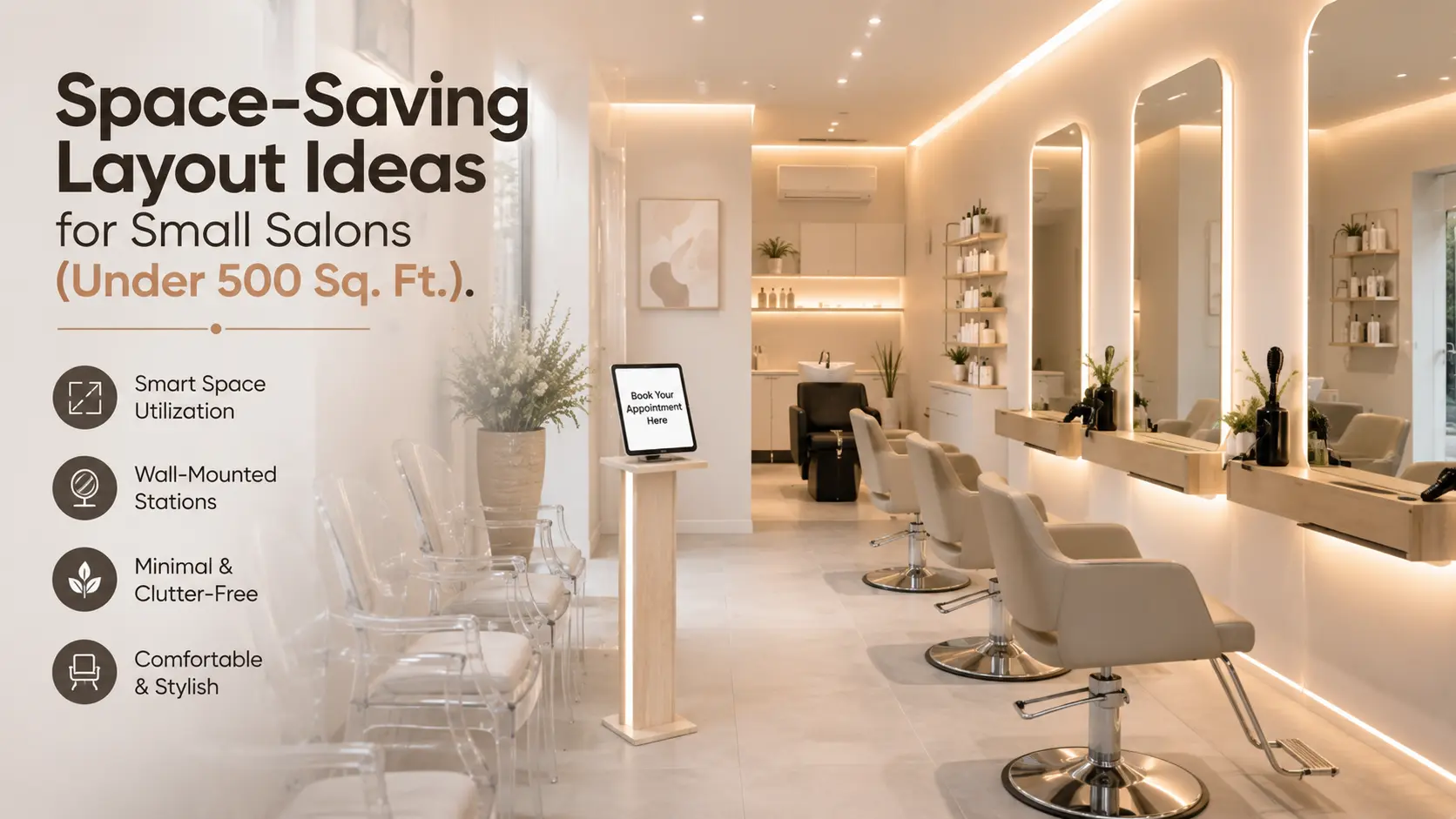
Introduction: The Boutique Revolution in 2026
In the high-rent districts of Mumbai, Delhi, and Bangalore, the traditional “mega-salon” model is undergoing a massive structural shift. High real estate costs and a consumer preference for intimate, personalized experiences have made the boutique studio the most profitable business model in 2026. However, working with a space under 500 square feet presents a unique architectural challenge. How do you fit three styling stations, a shampoo bowl, a waiting area, and a stockroom without making the client feel claustrophobic? The secret lies in a scientifically engineered small salon layout.
Designing a small salon layout is not merely about picking the right furniture; it is about “Spatial Intelligence.” It requires a transition from traditional salon interior design to a high-efficiency salon setup that utilizes every cubic inch of the room. In a small space, clutter is your primary enemy. If your physical operations—like billing stacks and overgrown inventory—are taking up space that could hold another styling chair, you are literally losing revenue.
In this 1600-word masterclass, we will deconstruct the “No-Desk” revolution, explore the psychology of beauty parlour decor, and reveal how the technological trinity of Stylelink, Lokaci Pro, and Zubito can physically free up to 20% of your floor space. Whether you are launching a new startup or renovating an existing boutique, it is time to master the art of maximizing space without compromising on luxury.
Industry Standard: Elite brands like The Salon Company have perfected the “Micro-Boutique” concept, proving that a 400 sq. ft. space can generate more profit than a 1500 sq. ft. outlet if the flow is optimized. (Pro Tip: For boutique owners looking to hire versatile talent that can handle multiple roles in a small space, the Stylelink app is your definitive hiring partner).
The Core Philosophy of a Small Salon Layout: Zones over Walls
The first mistake owners make in salon interior design for tight spaces is using solid partitions. Walls are the enemy of 500 sq. ft. studios. A successful small salon layout utilizes “Visual Zoning”—the use of floor textures, lighting, and glass to define areas without blocking the eye. When the eye can travel from one end of the room to the other, the brain perceives the space as 30% larger than its actual dimensions.
The “Circular Flow” Model
Instead of a traditional linear salon setup (where chairs are all in one line), modern layouts use a circular or “Diamond” flow. By angling the stations at 45 degrees, you create more elbow room for the stylist and prevent clients from staring at each other in the mirrors, which is a common discomfort in a small salon layout.
Step 1: Maximizing Space Through Vertical Thinking
When you run out of floor space, look at your walls. In a small salon layout, every wall must be a functional asset. Beauty parlour decor should be integrated into the storage system.
- Recessed Shelving: Instead of bulky cabinets that protrude into the walking aisle, use wall-cavity shelving. This keeps your backbar products visible but flush with the wall.
- Suspended Tool Stations: Floor-standing trolleys are the #1 space-wasters. Use ceiling-suspended or wall-mounted swing arms for blow-dryers and trimmers. This keeps the floor clear, making the small salon layout much easier to clean and navigate.
- Pegboard Decor: Use aesthetic matte-black pegboards to display retail products. It acts as both beauty parlour decor and a flexible inventory display.
Step 2: The “No-Desk” Revolution with Lokaci Pro
The single biggest waste of square footage in a small salon layout is the massive, wooden reception desk. Historically, you needed a desk to hold a bulky PC, a printer, and stacks of paper registers. In 2026, this is dead space. By adopting Lokaci Pro, you can eliminate the reception desk entirely.
How Technology Saves Physical Space:
• Tablet-Based Billing: Lokaci Pro is a cloud-based billing software. Your receptionist or stylists can handle checkouts, appointments, and payments on a sleek iPad while standing anywhere in the salon.
• Digital Records: Say goodbye to cabinets full of client cards and tax files. Everything is securely stored in the Lokaci Pro cloud.
• Space ROI: Removing a traditional 4×4 ft reception desk frees up enough room for an additional styling station or a premium retail shelf. In a small salon layout, that extra chair can generate ₹1.5 Lakhs in additional monthly revenue.
Step 3: Strategic Beauty Parlour Decor: Light and Reflection
In salon interior design, your color palette and mirror placement are your primary tools for maximizing space visually.
- The Mirror Wall: Use floor-to-ceiling mirrors behind your styling stations. This doesn’t just look luxurious; it creates an “Infinite Reflection” that makes a narrow small salon layout feel twice as wide.
- Monochromatic Palettes: Avoid using too many contrasting colors. A monochromatic scheme (like different shades of cream, beige, or grey) creates a seamless visual flow. When the furniture matches the walls, the salon setup feels airy and light.
- Translucent Furniture: Consider using ghost chairs (acrylic) for your waiting area. They provide seating functionality without adding “Visual Weight” to the room.
Step 4: The “Just-In-Time” Supply Chain via Zubito
In a 500 sq. ft. small salon layout, you do not have the luxury of a 100 sq. ft. stockroom. Storing 50 cases of shampoo is a waste of your most valuable real estate. Modern boutique owners utilize the “Lean Inventory” model.
Because your Lokaci Pro software is natively integrated with Zubito supply, you can automate your procurement. The system tracks your usage down to the gram and places micro-orders on Zubito for rapid delivery. Instead of a massive stockroom, you only need a small “Active Cabinet.” This allows you to convert your old stockroom into a private facial room or a luxury head-spa cabin, significantly increasing your service menu variety.
Step 5: Hiring Versatile Talent with Stylelink
A small salon layout requires a “Small but Mighty” team. In a large salon, you can afford to have a dedicated shampoo boy, a dedicated receptionist, and a dedicated cutter. In a boutique salon setup, you need “Hybrid Professionals”—stylists who can consult, cut, color, and manage their own digital billing via the Stylelink app.
Here is how the Stylelink ecosystem helps you staff your boutique:
- Filter for “Multi-Skilled” Artists: Use the Stylelink App to find professionals who have multiple certifications. A stylist who is also an expert in eyelash extensions or bridal makeup is worth 2x their salary in a small space.
- Visual Vetting: View digital portfolios on Stylelink to ensure their aesthetic matches your beauty parlour decor. A boutique salon relies heavily on “Brand Consistency.”
- Manage High-Yield Appointments: Use Lokaci Pro to track which services are generating the most profit per square foot. If your data shows that “Nail Art” has a higher ROI than “Haircuts” for your specific location, you can easily adjust your small salon layout to add another nail desk.
Lighting Strategy: Illuminating the 500 Sq. Ft. Void
Poor lighting makes a small room feel like a cave. To make your small salon layout feel expansive, you must use “Perimeter Lighting.” Instead of one central light, place LED strips along the edges of the ceiling and under the bottom of your stations. This “Glow” effect pushes the walls back visually. Ensure your task lighting is 5000K neutral daylight to maintain color accuracy while keeping the beauty parlour decor looking vibrant and clean.
Operational Flow: The “Zone” Mapping
To avoid staff and clients bumping into each other, your small salon layout must follow a strict “Wet to Dry” zoning rule:
| Zone | Location | Maximizing Space Tip |
|---|---|---|
| The Welcome Zone | Front Entrance | Replace desk with an iPad stand and a single luxury armchair. |
| The Wet Zone | Back Corner (Near Plumbing) | Use a “European-Style” lay-flat backwash to save 2 feet of space. |
| The Style Zone | Center/Sides | Use wall-mounted “Floating Stations” with no legs. |
| The Retail Zone | Eye-Level Walls | Use vertical glass shelves above the styling mirrors. |
Conclusion: Small Space, Massive Revenue
Designing a small salon layout is an exercise in editing. It is about removing the “unnecessary” (bulky desks, paper files, excess stock) to make room for the “essential” (talented artists and comfortable guests). In 2026, a 500 sq. ft. salon run on the Lokaci Pro and Stylelink ecosystem can out-perform a traditional salon triple its size through sheer operational efficiency and maximizing space.
Stop viewing your limited square footage as a hurdle. Professionalize your salon setup today by digitizing your operations. Experience the power of paperless management by booking a demo of Lokaci Pro. Build your versatile dream team via the Stylelink App. And for the ultimate benchmark in boutique luxury, follow the clinical path set by The Salon Company. The boutique era is here—make sure your salon is the most efficient and aesthetic one in the city!
Frequently Asked Questions (FAQs)
Q1: What is the most important piece of furniture to save space?
In a small salon layout, it is the “Wall-Mounted Station.” By removing the legs of your styling desks, you open up the floor. This allows the eyes to see more of the flooring, which is the #1 psychological trick for making a room feel larger.
Q2: How many chairs can I fit in 400 sq. ft.?
With an optimized small salon layout and no physical reception desk, you can comfortably fit 3 styling stations, 1 shampoo unit, and a small waiting chair. The key is using Lokaci Pro to handle the check-in process digitally so you don’t need a lobby.
Q3: Should I use dark or light colors for salon interior design?
Always go for light, reflective colors. Whites, creams, and pale pastels reflect light, while dark colors absorb it and make walls feel like they are closing in. Use dark colors only for “accents” in your beauty parlour decor.


