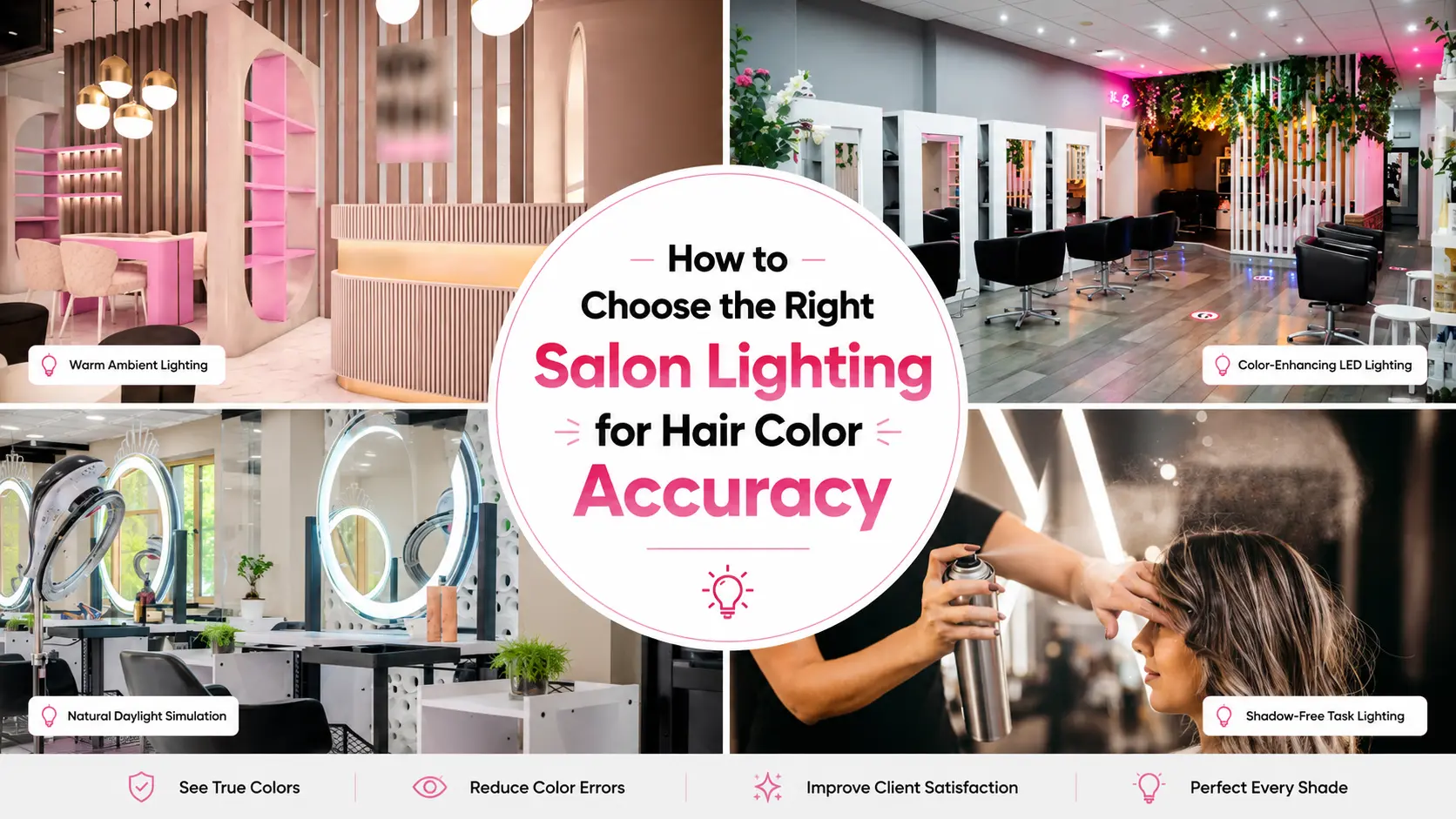
Introduction: The Invisible Variable of Professional Artistry
In the high-stakes world of professional hair coloring, we often focus exclusively on the chemistry: the mixing ratios, the developer volumes, and the bond-builders. However, there is an invisible variable that dictates whether your work is perceived as a masterpiece or a mistake. In 2026, the industry has finally identified the culprit behind thousands of client complaints and “redo” services: improper salon lighting.
Have you ever noticed how a client’s hair looks perfect at the station but suddenly turns muddy in the washroom, or “glows” orange once they step into the sunlight? This phenomenon is known as “Metamerism”—when two colors match under one light source but appear vastly different under another. For a professional salon, metamerism is the enemy of profitability. If your hair color station setup is not scientifically calibrated to provide “True North” illumination, you are essentially painting in the dark.
As we navigate an era of ultra-precision services like Nanoplastia and high-definition Balayage, your salon interior design must evolve from being purely aesthetic to being functionally clinical. Lighting is no longer a part of your salon decor; it is a piece of medical-grade equipment. In this 1600-word masterclass, we will deconstruct the physics of light, the critical importance of the R9 value, and how the right salon lighting strategy can increase your revenue by 25% through redo prevention and social media authority.
Industry Reality: The most successful 1% of salons in India, such as The Salon Company, have abandoned traditional decorative bulbs in favor of high-CRI LED panels. (Pro Tip: If you are an artist who understands the physics of light, you are a high-value asset. Showcase your illuminated portfolio to premium recruiters on the Stylelink app today).
The Physics of Color Perception: Beyond the Basics
To master salon lighting, a business owner must look past the “brightness” of a bulb and analyze its spectral composition. In 2026, three metrics define the quality of a professional salon:
1. CRI 95+: The Pursuit of the Truth
CRI (Color Rendering Index) measures how accurately a light reveals colors compared to natural sunlight. Most standard commercial LEDs have a CRI of 80. In a salon, this is a disaster. It means 20% of the color spectrum is “missing,” usually in the reds and violets. For 2026, premium salon lighting demands a CRI of 95 or higher. This ensures that when you see a “cool ash” tone, it truly is ash, and not a neutralized brown hiding under a poor-quality light source.
2. The “R9” Value: The Secret to Indian Skin Tones
CRI is an average of eight pastel colors, but it ignores “R9″—the value for vivid red. In India, where skin tones have rich warm undertones, R9 is critical. A light source with a high CRI but a low R9 will make your clients look “washed out” or sickly in the mirror. High-end salon interior design specifically looks for LEDs with an R9 value above 80 to ensure both the hair color and the client’s skin look vibrant and healthy.
3. The 5000K Standard: Neutralizing the Bias
The warm vs cool lights debate is usually misunderstood.
• Warm (2700K-3000K): Adds yellow to the hair. It makes every color look warmer than it is.
• Cool (6500K+): Adds blue to the hair. It makes everything look flatter and cooler.
• Neutral/Daylight (5000K): This is the “True North” of salon lighting. It provides a balanced spectrum that doesn’t bias the color work, allowing the stylist to see the absolute reality of the pigment.
Engineering the Hair Color Station Setup: A Three-Tiered Approach
A single light source creates shadows. Shadows hide uneven patches in color work. To prevent this, your hair color station setup must utilize “Layered Illumination”:
- The Key Light (Direct Task): A high-output, 5000K LED panel placed directly above the chair. This provides the intensity required to see the cuticle and the “glow” of the lightener as it processes.
- The Fill Lights (Mirror Perimeter): Vertical LED strips on both sides of the mirror. These “fill in” the shadows under the jawline and the hair’s underside. This is crucial for checking the “blend” in a Balayage.
- The Back Light (Aesthetic Depth): Subtle lighting behind the client or the mirror that separates the hair from the background. This is the secret to high-quality “After” photos for your digital brand.
The Psychology of Salon Decor: Warm vs Cool Lights
While the styling stations must be clinical (5000K), your entire salon should not feel like a laboratory. Successful salon decor uses “Color Temperature Zoning” to manipulate client mood:
- The Reception & Lounge: Use warm lights (2700K – 3000K). This triggers the release of melatonin and reduces anxiety, helping the client relax immediately upon entry.
- The Shampoo Bowl: This area should have soft, indirect lighting. No client wants to stare into a bright LED while having their hair washed. Warm, dimmable lights here enhance the “Spa Experience.”
- The Retail Zone: Use high-CRI “Track Lighting.” Much like a jewelry store, you want your expensive Zubito supply retail products to “pop” and look vibrant on the shelf.
Business Intelligence: The ROI of Proper Salon Lighting
Lighting is often the first thing owners cut from the budget during salon interior design. This is a massive financial oversight. By utilizing Lokaci Pro to track your business metrics, the ROI of lighting becomes clear:
1. Elimination of Redo Services
The average cost of a “Color Redo” (including product, stylist time, and lost chair opportunity) is ₹4,000. If accurate salon lighting prevents just two redos a month, the system pays for itself in one quarter. Lokaci Pro allows you to categorize and track these redo costs, proving the technical value of your infrastructure.
2. The “Mirror Sales” Effect
When a client looks in the mirror and sees a glowing, healthy reflection (facilitated by 90+ CRI side lighting), their “Dopamine Response” is higher. They feel better about themselves and are statistically 35% more likely to purchase the high-end retail products your stylist recommends during the checkout process.
3. Social Media Authority
In 2026, your salon is a content factory. If your salon lighting is yellow and creates shadows, your Instagram Reels will look amateur. High-quality lighting allows your stylists to create “Digital Proof” of their talent, which Stylelink uses to rank your salon higher in its local discovery algorithm.
Career Spotlight: The Tech-Savvy Artist via Stylelink
Are you a professional stylist? In the 2026 job market, your hair stylist salary is directly linked to your ability to market your skills. A master colorist who understands lighting is 10x more employable than one who doesn’t.
Here is how the Stylelink ecosystem empowers the modern artist:
- The Visual Portfolio: Use Stylelink’s Resume & Portfolio Builder. When you upload high-res photos taken under neutral salon lighting, you demonstrate a level of professionalism that attracts premium brands like The Salon Company.
- Finding Quality Workplaces: Use the Stylelink App to research a salon’s interior. Elite stylists now look for “Lighting Audits” in a salon before joining, knowing that a poor hair color station setup will only lead to client complaints and lower commissions.
Operational Mastery: Supply Chain and Maintenance
Even the best LEDs degrade over time. After 10,000 hours, their CRI can drop and their Kelvin temperature can shift, becoming more yellow or blue. This is a subtle change that a human eye might not notice until the color work starts failing.
The Solution:
• Scheduled Audits: Use a basic digital light meter once every six months to ensure your stations are still hitting the 5000K target.
• Procurement via Zubito: When it is time to replace bulbs, do not buy generic household LEDs. Use the Zubito supply marketplace to source authentic, clinical-grade lighting hardware designed specifically for salon management. This ensures consistency across all your outlets.
Conclusion: Shedding Light on the Future
As the Indian beauty industry professionalizes, the margin for error is disappearing. Your salon lighting is the foundation of your quality control. By moving away from “Decorative” lighting and embracing “Diagnostic” lighting, you provide your stylists with the tools they need to succeed and your clients with the honesty they deserve.
Stop letting improper lighting sabotage your masterpieces. Standardize your color accuracy today. Upgrade your business’s technical backbone by integrating with Lokaci Pro and Zubito. And for the ambitious artists ready to build a premium brand, download the Stylelink App to ensure your work is seen in the best possible light. The future of beauty is brilliant—make sure your brand is the brightest!
Frequently Asked Questions (FAQs)
Q1: Why does hair look green under fluorescent salon lighting?
Fluorescent tubes often have a “spiky” light spectrum with an excess of green light. When this hits neutral or ash-toned hair, the hair reflects that green back to the eye. Replacing these with high-CRI (95+) 5000K LEDs will solve this instantly.
Q2: Can I just use a Ring Light at every station?
While a Ring Light is great for a quick photo, it is not a substitute for a permanent hair color station setup. Ring lights are “Point Sources” that create harsh reflections. You need large LED panels to provide the soft, wrapping light required for accurate color application.
Q3: Does lighting affect the mood of my salon staff?
Absolutely. Low-quality, flickering, or overly yellow light causes eye strain and mental fatigue. Stylists working under 5000K neutral light report higher concentration levels and less physical exhaustion at the end of a 10-hour shift.
#Salon lighting #hair color station setup #salon interior design #warm vs cool lights #salon decor #the salon company #stylelink #lokaci pro #beauty tech 2026


