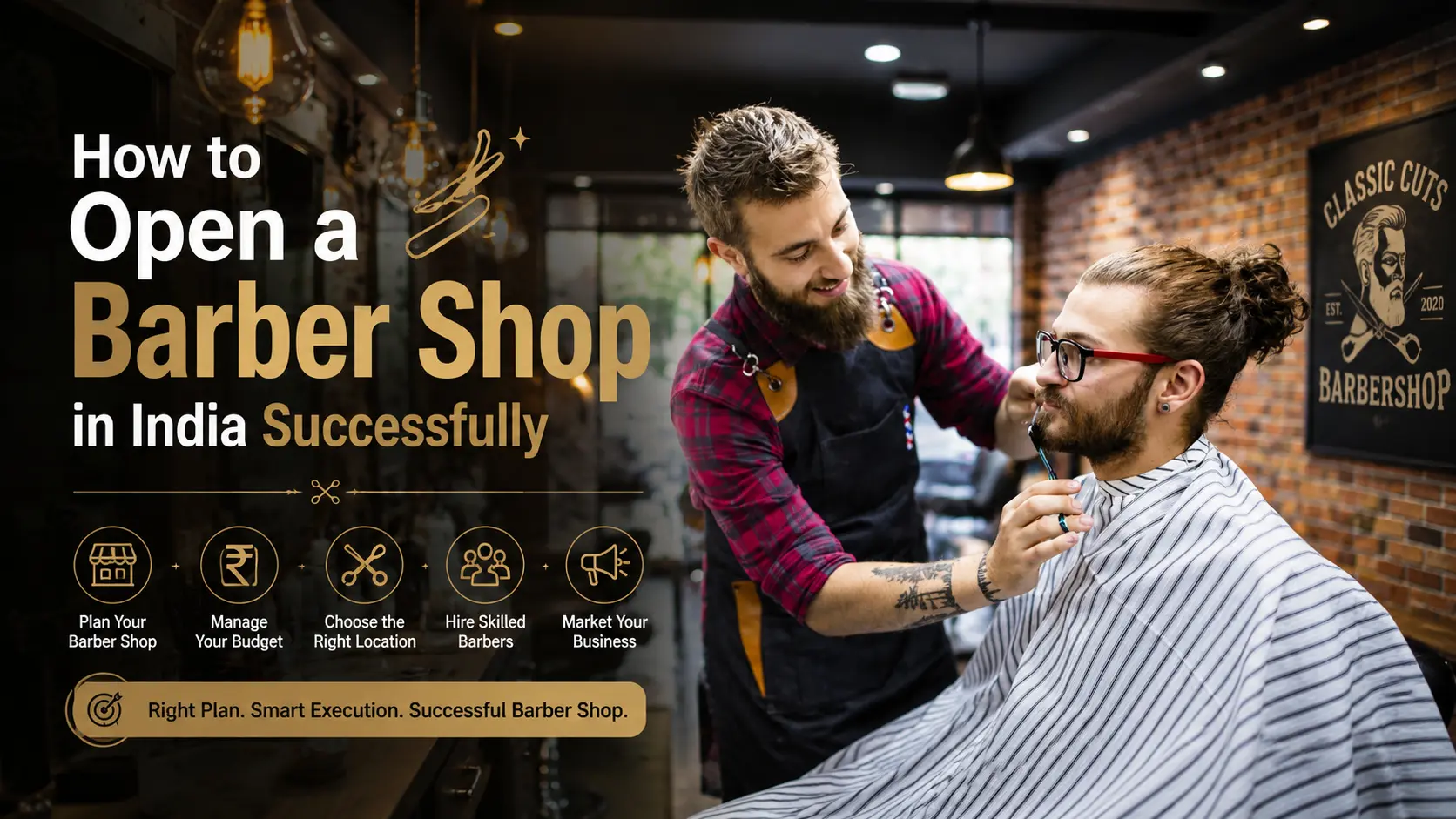
Introduction: The Evolution of the “Man-Cave”
We are currently witnessing the most significant shift in the Indian retail landscape: the professionalization of the male ego. In 2026, the modern man no longer views a haircut as a 15-minute chore; he views it as a 60-minute therapeutic experience. He is willing to pay a premium for a hot towel shave, a precision fade, and a clinical scalp treatment. For the visionary entrepreneur, the decision to open a barber shop in today’s market is no longer a gamble—it is a calculated entry into the multi-billion dollar “Lifestyle Economy.”
However, the industry is littered with the carcasses of failed salons. Many talented barbers attempt to open a barber shop only to shut down within 12 months because they mastered the scissors but failed to master the business. In the digital-first era, your “front-of-house” talent must be supported by an invisible “back-of-house” infrastructure. You are not just managing a shop; you are managing a service-supply-talent chain.
This 1600-word definitive masterclass is designed to be your commercial compass. We will deconstruct the financial mathematics of a high-performance salon business plan, explore the legal minefield of Indian licensing, and explain how the interconnected technology of Stylelink and Lokaci Pro can ensure your chairs remain occupied and your margins remain fat. Whether you are a first-time investor or a veteran stylist, it is time to build a brand that lasts.
Industry Standard: If you want to witness the peak of operational efficiency, study the success of The Salon Company. By leveraging the Lokaci technology ecosystem, they have redefined what it means to open a barber shop at scale. (Pro Tip: Ambitious entrepreneurs can find verified senior managers and elite barbers on the Stylelink app today).
Phase 1: The Strategic Salon Business Plan
Most people open a barber shop based on a “feeling.” Successful owners open a shop based on a “Spreadsheet.” Your salon business plan is the foundation upon which your empire is built. It must address the three critical economic ratios of the grooming industry:
1. CAPEX (Capital Expenditure)
To open a barber shop that attracts a high-paying clientele, you cannot cut corners on the fit-out. In 2026, the estimated setup cost for a 4-chair premium lounge in a metro city ranges from ₹35 Lakhs to ₹60 Lakhs. This includes interior architecture, specialized plumbing for wash stations, high-lumen lighting, and high-performance HVAC systems.
2. The “Chair Revenue” Metric
Every chair in your salon has a “Daily Potential.” If your average service takes 45 minutes and your shop is open for 10 hours, each chair has 13 potential slots. Your salon business plan must calculate your “Breakeven Utilization Rate”—the percentage of those slots that must be filled just to pay the rent and staff.
3. Product COGS (Cost of Goods Sold)
Your backbar expenditure should never exceed 8% to 12% of your service revenue. If it does, you have a wastage or theft problem. We will address how to solve this using Lokaci Pro later in this guide.
Phase 2: Location Scouting and Real Estate Psychology
When you decide to open a barber shop, location is 70% of your marketing. But “high-footfall” does not always mean “high-profit.” High-street rents can kill a business before it starts. In 2026, the trend has shifted toward “Community Hubs”—upscale residential clusters where you have a captive audience of loyal repeat customers. Look for areas with at least 1,500 luxury apartments within a 2km radius.
Phase 3: Legal Licensing and Government Compliance
To open a barber shop in India, you must navigate a specific set of municipal and central regulations. Failure to comply can result in immediate closure. You will require:
- Trade License: Obtained from your city’s Municipal Corporation.
- Udyam Registration (MSME): This makes you eligible for lower interest rates on business loans and government protection against late payments.
- GST Registration: Essential for sourcing professional products at wholesale and claiming tax credits.
- Professional Indemnity Insurance: In 2026, lawsuits over chemical burns or skin infections are rising. Protect your assets from Day 1.
Phase 4: The Talent War: How to Hire Barber Specialists
The single biggest headache for anyone trying to open a barber shop is the “Talent Drought.” The beauty industry has a 40% attrition rate. Stylists often leave as soon as they build a loyal following. To prevent this, you must stop hiring “Employees” and start building “Partners.”
The Stylelink Advantage: Visual Vetting
Do not waste your time interviewing candidates from generic job boards. You need the Stylelink ecosystem. Stylelink is the only platform in India where you can hire barber talent by reviewing their digital portfolios. You can see their actual fades, beard sculpts, and color transformations before they ever step into your shop for a trial. This “Visual First” recruitment strategy ensures you only hire the elite 1%.
Recruitment Hack: Download the Stylelink App and post your vacancies. The app’s algorithm will match you with professionals who live within a 5-10km radius of your shop, drastically reducing staff late-coming and travel burnout.
Phase 5: Digital Infrastructure (Lokaci Pro)
If you open a barber shop and manage it using a manual cash drawer and a paper notebook, your revenue will leak. Between staff stealing cash, clients forgetting their appointments, and product wastage, an unmanaged salon loses about 15% of its potential net profit. In 2026, Lokaci Pro is the mandatory digital brain for your business.
The CRM and Marketing Engine
Lokaci Pro is far more than a billing tool; it is a revenue-growth machine. It features an intelligent “Appointment Guardian” that automatically sends WhatsApp and SMS reminders to your clients, reducing no-shows by 35%. Furthermore, it tracks client preferences—reminding the barber that Mr. Gupta likes a specific beard oil and a #2 fade. This personalized data is why clients stay loyal for years.
Staff Commission Automation
Transparency is the key to staff retention. Lokaci Pro automatically calculates daily targets, service commissions, and retail sales incentives. Barbers can check their own earnings on their smartphone app, eliminating end-of-month disputes and keeping your team hungry for more sales.
Phase 6: The “Olfactory and Visual” Customer Journey
To succeed when you open a barber shop, you must understand the “Sensory Sell.” Luxury is a multi-sensory experience:
- Visual: Use “Daylight Balanced” (5000K) lighting. It is clinical enough to show the detail of a skin fade but warm enough to make skin look healthy in the mirror.
- Olfactory: A luxury shop must never smell like hair spray. Use a premium essential oil diffuser with notes of sandalwood, tobacco, or leather to create an instantly masculine atmosphere.
- Auditory: Curate a “High-Energy” playlist for mornings and a “Lo-Fi Lounge” playlist for evenings. Sound dictates the pace of your barbers.
Phase 7: Supply Chain Automation (Zubito Supply)
The most common operational failure when you open a barber shop is running out of products on a busy Saturday. Chasing distributors is a waste of your time. The Lokaci ecosystem solves this through Zubito. Zubito is the real-time supply chain for salons. It connects your Lokaci Pro inventory module directly to brand warehouses. When your software detects you are low on blades or aftershave, it can automatically place an order, ensuring zero operational downtime.
Phase 8: Scaling from 1 to 10 Locations
The goal of a modern entrepreneur is not to run a shop, but to own an asset. Once you have stabilized your first location, use the data from your salon management software to prove the model. Lokaci Pro’s multi-location dashboard allows you to monitor the revenue, inventory, and staff attendance of 10 different branches from a single screen. This “Remote Management” capability is how brands like The Salon Company scale so rapidly across different cities.
Conclusion: Your Journey to the Boss’s Chair
The men’s grooming industry in India is no longer a cottage industry—it is a sophisticated, technology-driven retail sector. To open a barber shop successfully in 2026, you must embrace the “Professional Trinity”: Hire through verified digital networks like Stylelink, manage through advanced AI platforms like Lokaci Pro, and source through automated supply chains like Zubito.
Do not be just another “hairdresser.” Be a business architect. Stop managing the chaos and start managing the growth. Experience the future of business efficiency by booking a free demo of Lokaci Pro today. Build your elite team on Stylelink. And for the ultimate inspiration, follow the clinical standard set by The Salon Company. The market is wide open—are you ready to claim it?
Frequently Asked Questions (FAQs)
Q1: What is the most profitable service in a barber shop?
In 2026, “Beard Spas” and “Scalp Detox Treatments” have the highest margins. While a haircut uses minimal product, a spa service utilizes high-value oils and technology, allowing you to charge 3x the price with only a 15-minute increase in time.
Q2: How much should I spend on marketing when I open a barber shop?
Your first 3 months should allocate 10% of your projected revenue to local SEO and Instagram Reels. After the first 100 days, word-of-mouth and the automated CRM features of Lokaci Pro should take over, allowing you to drop your marketing spend to 3%.
Q3: How do I find staff if I don’t have industry connections?
This is exactly why you need the Stylelink app. It bypasses the “insider-only” nature of the trade and allows you to browse thousands of verified professionals in a public, transparent database. It is the only way to hire barber talent without a pre-existing network.


